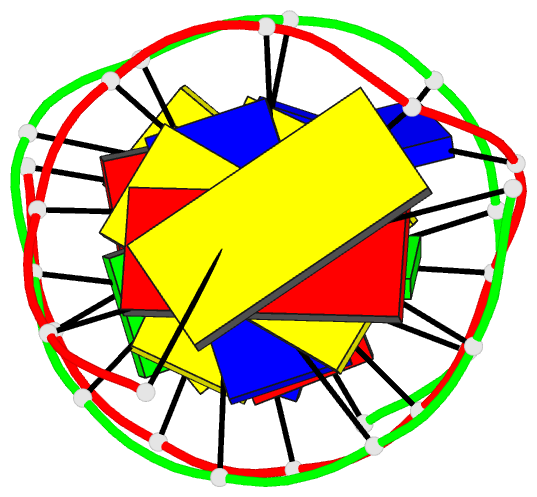
Summary information and primary citation
- PDB-id
-
1da4;
DSSR-derived features in text and
JSON formats
- Class
- DNA
- Method
- NMR
- Summary
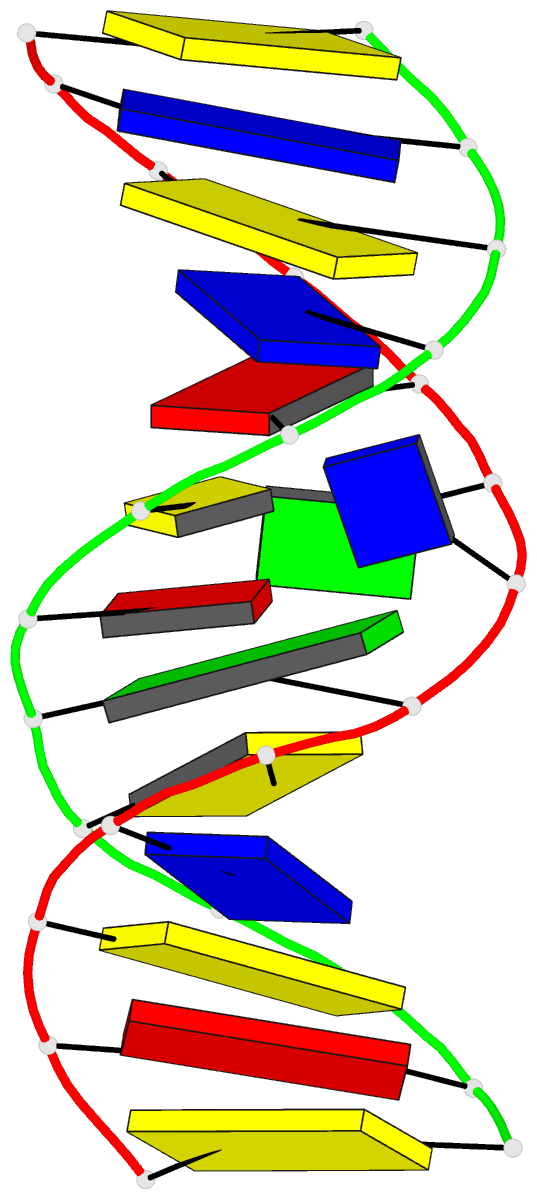
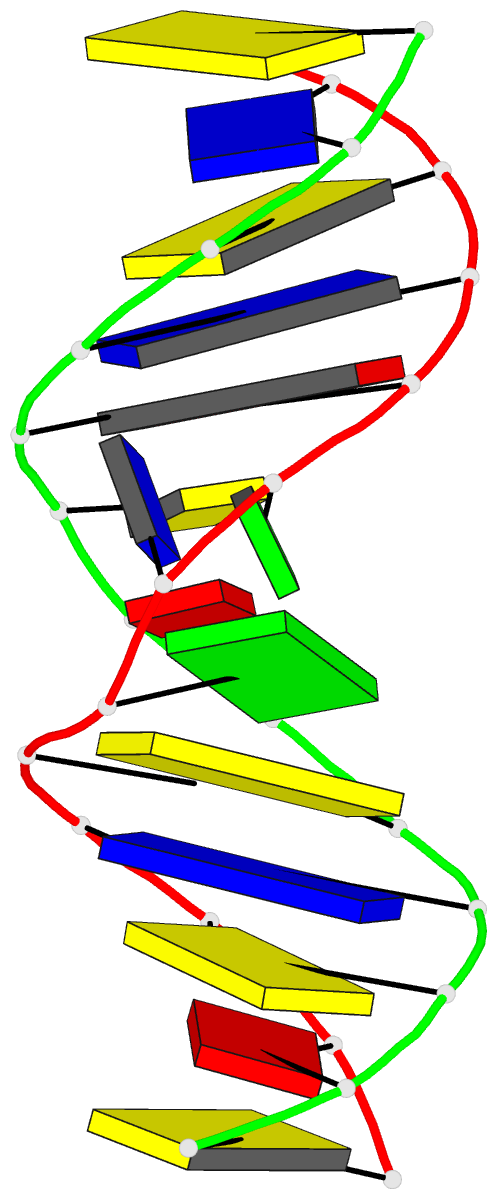
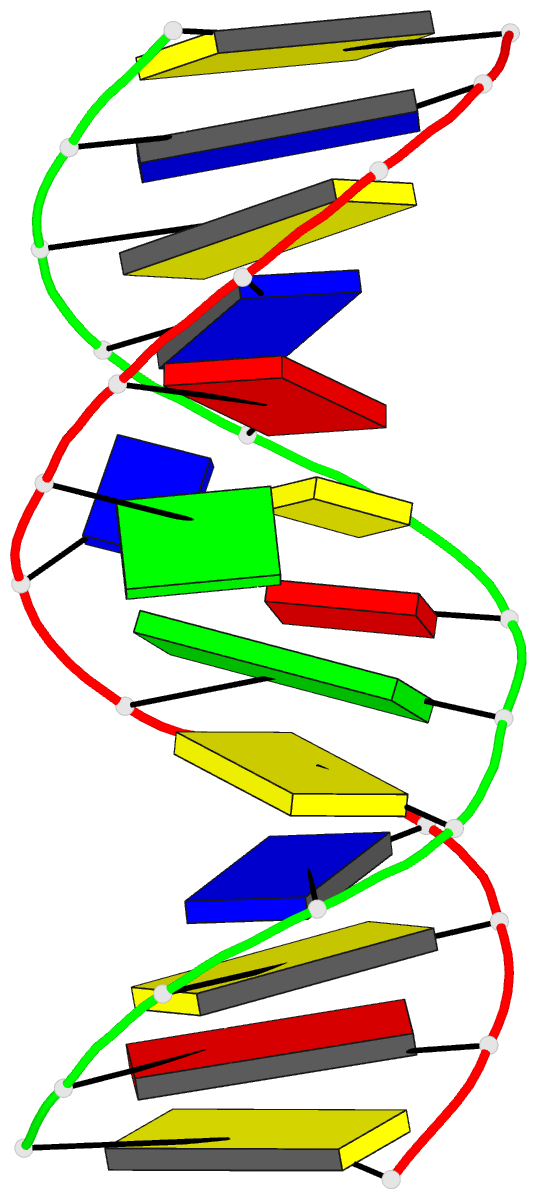
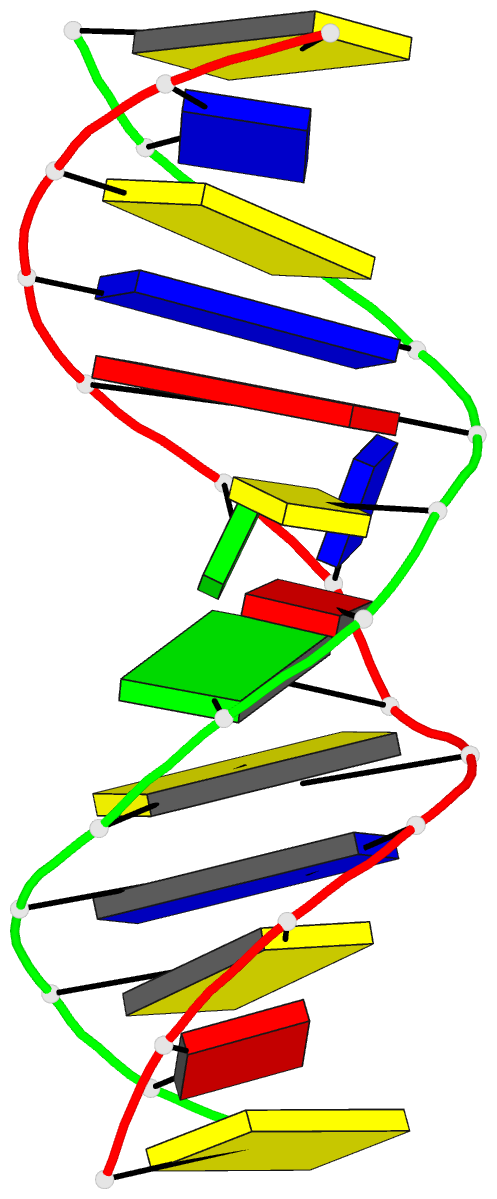
- Solution structure of a DNA duplex containing the
cis-pt(nh3)2[d(-gtg-)-n7-(g)-n7(g)n7(g)]adduct as
determined with high field NMR and molecular
mechanics-dynamics
- Reference
-
van Garderen CJ, van Houte LP (1994): "The
solution structure of a DNA duplex containing the
cis-Pt(NH3)2[d(-GTG-)-N7(G),N7(G)] adduct, as determined
with high-field NMR and molecular
mechanics/dynamics." Eur.J.Biochem.,
225, 1169-1179. doi: 10.1111/j.1432-1033.1994.1169b.x.
- Abstract
- The solution structure of the cis-Pt-GTG adduct in the
double-stranded oligomer d(CTCTAGTGCTCAC).td(GTGAGCACTAGAG)
was studied with high-resolution NMR techniques. For model
building, the distance information obtained from
two-dimensional NOE experiments was used in molecular
mechanic computations and molecular dynamic structure
refinements. The structural distortion upon platination
appears to be restricted to the base pairs Pt-G6.C21 and
T7.A20; Pt-G8.C19 forms a normal Watson-Crick base pair. T7
is positioned in the minor groove and stacks with the
highly propeller-twisted Pt-G6. There is no hydrogen
bonding between T7 and A20. The complementary strand is
undistorted; A20 stacks with its flanking cytidines (C19
and C21) as in regular B-DNA. The duplex is locally unwound
(from base pair A5.T22 to G8.C19: 19 degrees) and is
slightly kinked (20 degrees) at the platination site. The
platinum coordination distorts the DNA structure at the 5'
side of the platinated-GTG-sequence and changes the minor
groove face.