Summary information and primary citation
- PDB-id
-
1po6;
DSSR-derived features in text and
JSON formats
- Class
- RNA binding protein-DNA
- Method
- X-ray (2.1 Å)
- Summary
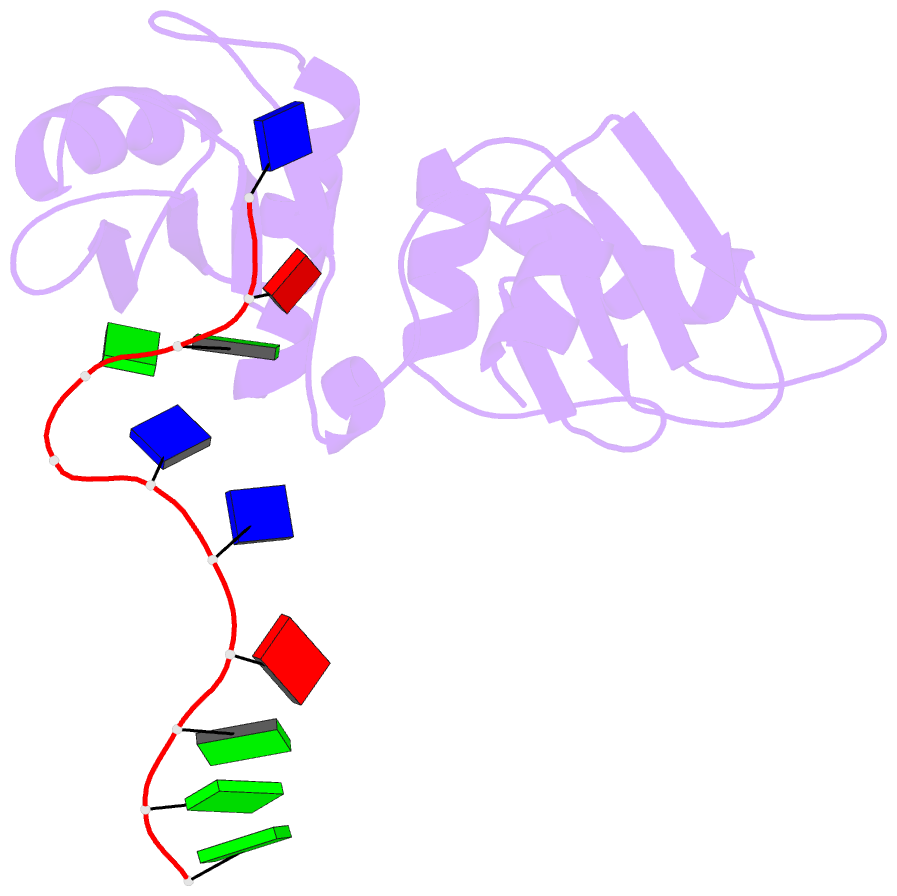
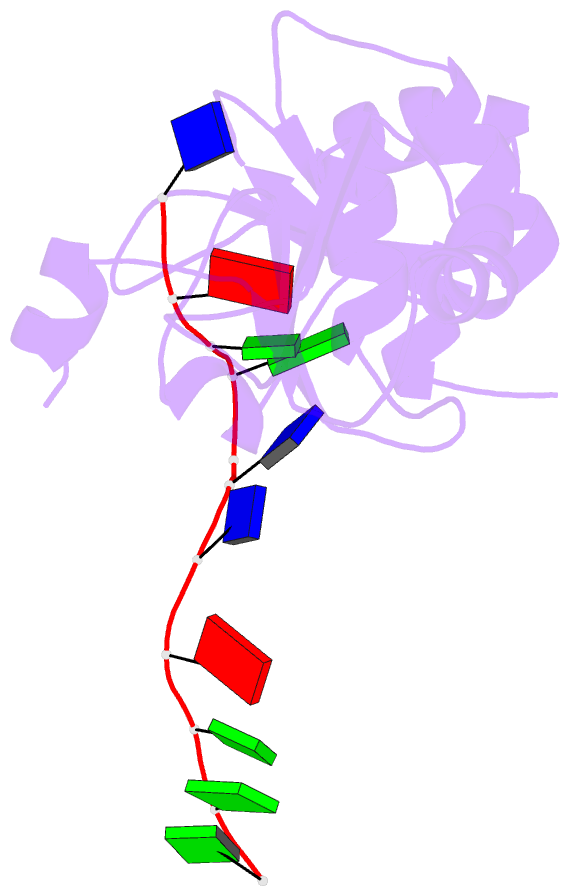
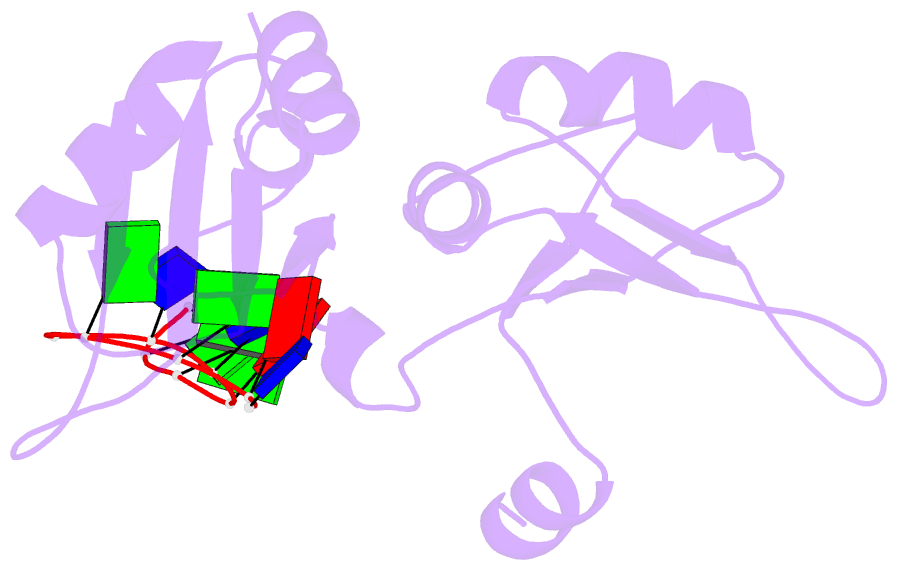
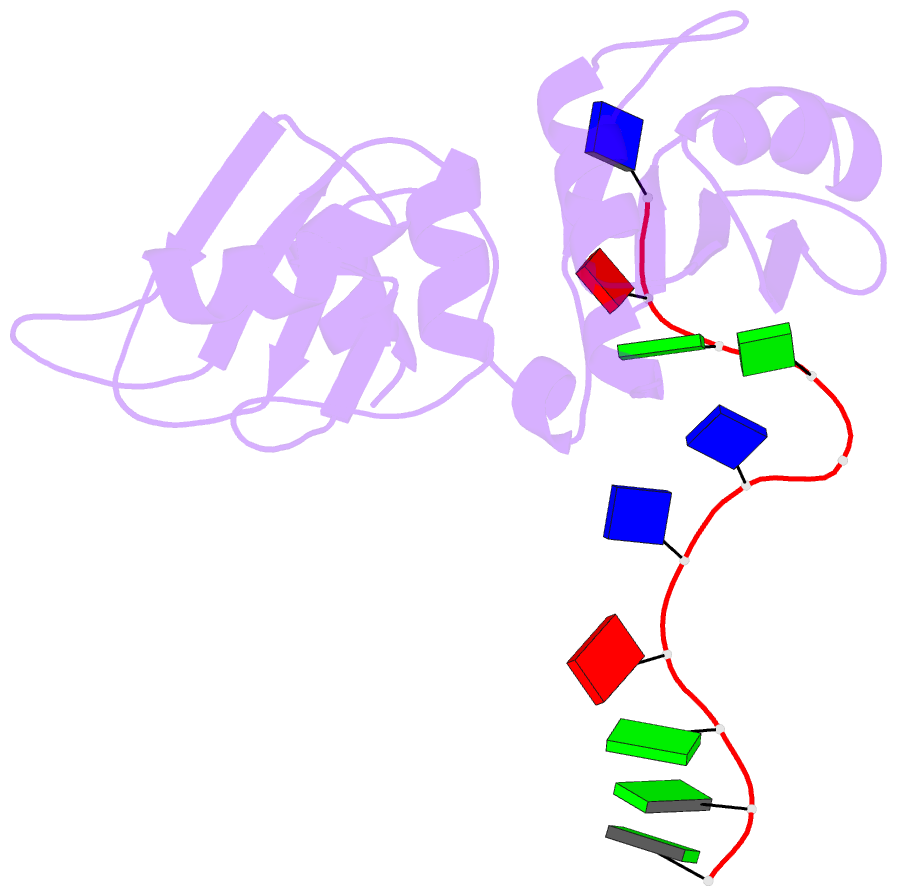
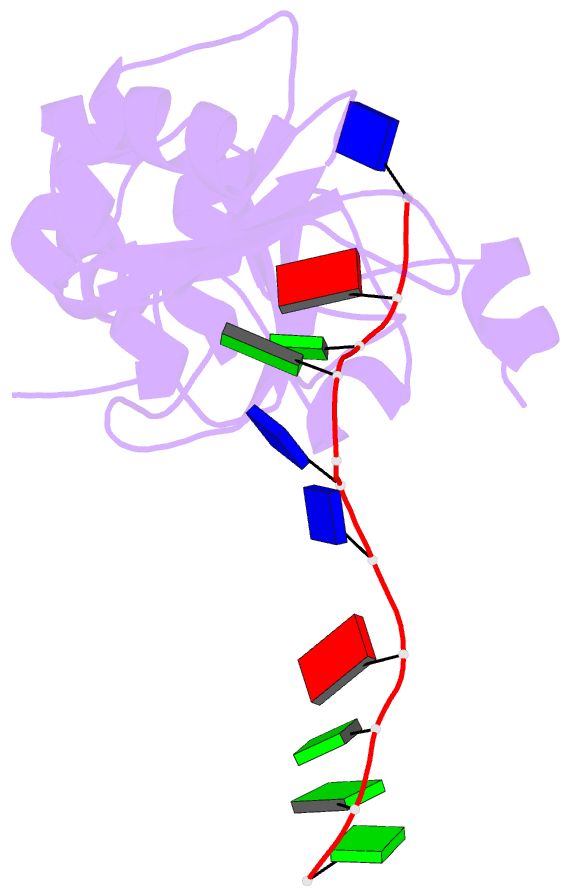
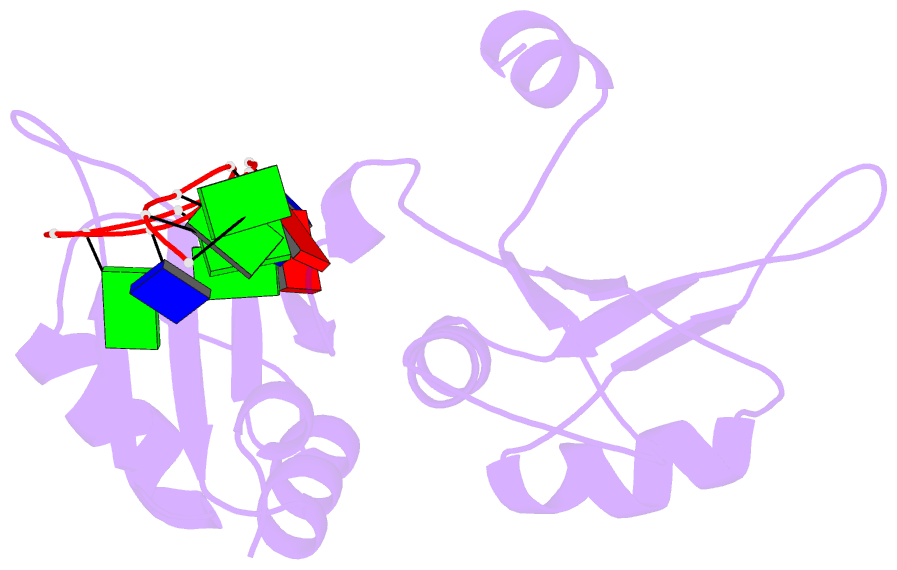
- Crystal structure of up1 complexed with
d(tagg(6mi)ttaggg): a human telomeric repeat containing
6-methyl-8-(2-deoxy-beta-ribofuranosyl)isoxanthopteridine
(6mi)
- Reference
-
Myers JC, Moore SA, Shamoo Y (2003): "Structure-based
incorporation of
6-methyl-8-(2-deoxy-beta-ribofuranosyl)isoxanthopteridine
into the human telomeric repeat DNA as a probe for UP1
binding and destabilization of G-tetrad structures."
J.BIOL.CHEM., 278, 42300-42306.
doi: 10.1074/jbc.M306147200.
- Abstract
- Heterogeneous ribonucleoprotein A1 (hnRNP A1) is an
abundant nuclear protein that participates in RNA
processing, alternative splicing, and chromosome
maintenance. hnRNP A1 can be proteolyzed to unwinding
protein (UP1), a 22.1-kDa protein that retains a high
affinity for purine-rich single-stranded nucleic acids,
including the human telomeric repeat (hTR) d(TTAGGG)n.
Using the structure of UP1 bound to hTR as a guide, we have
incorporated the fluorescent guanine analog 6-MI at one of
two positions within the DNA to facilitate binding studies.
One is where 6-MI remains stacked with an adjacent purine,
and another is where it becomes fully unstacked upon UP1
binding. The structures of both modified oligonucleotides
complexed to UP1 were determined by x-ray crystallography
to validate the efficacy of our design, and 6-MI has proven
to be an excellent reporter molecule for single-stranded
nucleic acid interactions in positions where there is a
change in stacking environment upon complex formation. We
have shown that UP1 affinity for d(TTAGGG)2 is
approximately 5 nm at 100 mm NaCl, pH 6.0, and our binding
studies with d(TTAGG(6-MI)TTAGGG) show that binding is only
modestly sensitive to salt and pH. UP1 also has a potent
G-tetrad destabilizing activity that reduces the Tm of the
hTR sequence d(TAGGGT)4 from 67.0 degrees C to 36.1 degrees
C at physiological conditions (150 mm KCl, pH 7.0).
Consistent with the structures determined by x-ray
crystallography, UP1 is able to bind the hTR sequence in
solution as a dimer and supports a model for hnRNP A1
binding to nucleic acids in arrays that may make a
contiguous set of anti-parallel single-stranded nucleic
acid binding clefts. These data suggest that seemingly
disparate roles for hnRNP A1 in alternative splice site
selection, RNA processing, RNA transport, and chromosome
maintenance reflect its ability to bind a purine-rich
consensus sequence (nYAGGn) and destabilize potentially
deleterious G-tetrad structures.