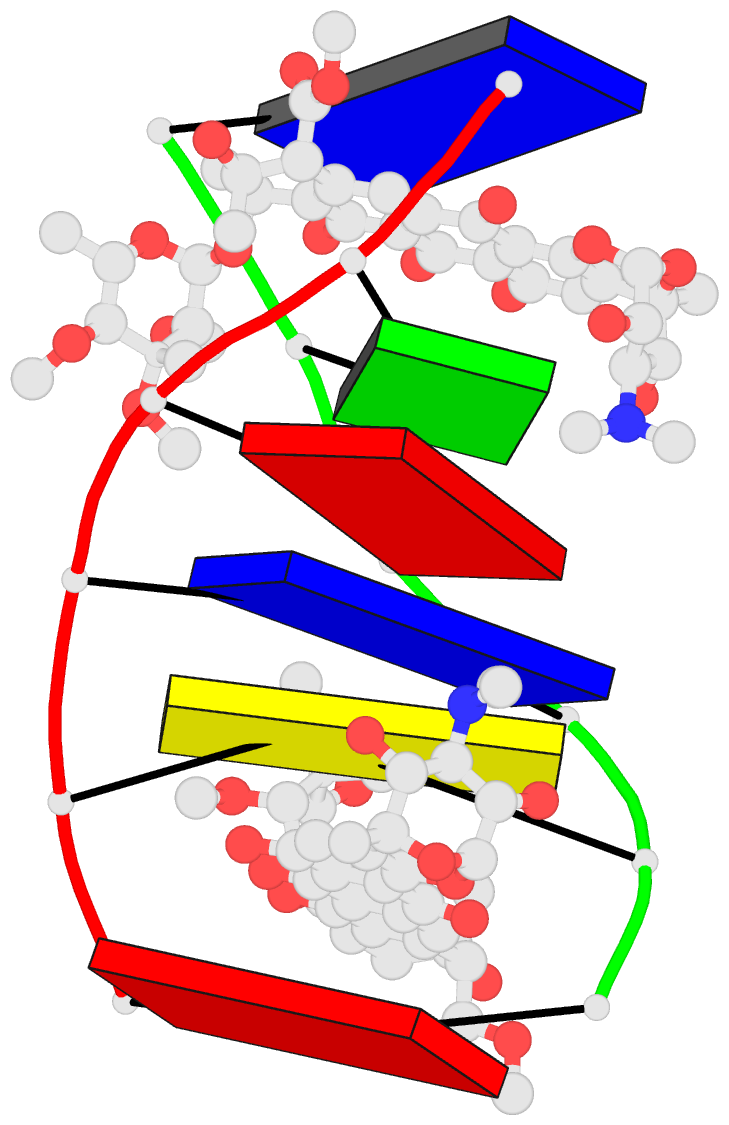
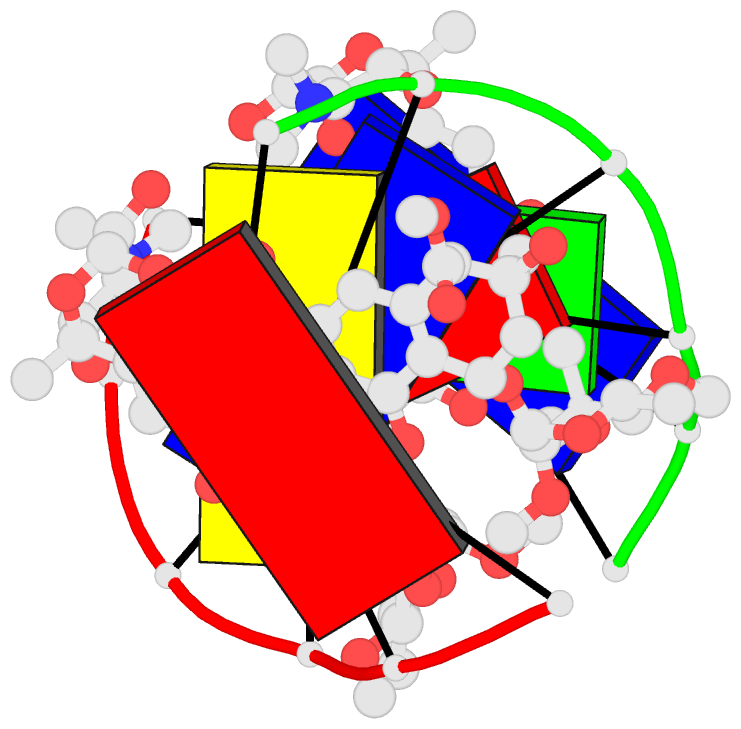
Summary information and primary citation
- PDB-id
-
224d;
DSSR-derived features in text and
JSON formats
- Class
- DNA
- Method
- X-ray (1.4 Å)
- Summary
- DNA-drug refinement: a comparison of the programs
nuclsq, prolsq, shelxl93 and x-plor, using the low
temperature d(tgatca)-nogalamycin structure
- Reference
-
Schuerman GS, Smith CK, Turkenburg JP, Dettmar AN, Van
Meervelt L, Moore MH (1996): "DNA-drug
refinement: a comparison of the programs NUCLSQ, PROLSQ,
SHELXL93 and X-PLOR, using the low-temperature
d(TGATCA)-nogalamycin structure." Acta
Crystallogr.,Sect.D, 52, 299-314.
doi: 10.1107/S0907444995012261.
- Abstract
- In an earlier study [Smith, Davies, Dodson & Moore
(1995). Biochemistry, 34, 415-425] the crystal structure of
the d(TGATCA)-nogalamycin complex was determined to 1.8 A
and refined with PROLSQ to R = 19.5% against 4767
reflections with F> 1sigma(F). A low-temperature
crystallographic study on this complex has now been
performed. Native data collection at liquid-nitrogen
temperature (120 K) improved the resolution to 1.4 A. The
structure has now been refined against these new
diffraction data in the resolution range 8-1.4 A using
NUCLSQ, PROLSQ, SHELXL93 and X-PLOR, in order to determine
to what extent the resulting DNA conformation and
associated solvent structure would differ and to examine
the suitability of these programs for the refinement of
oligonucleotide structures. With the advent of more
DNA-protein structure determinations, it is of interest to
see how well the protein-refinement packages, PROLSQ and
X-PLOR, and the small-molecule program, SHELXL93, are able
to accommodate DNA. Comparisons are made between the
dictionaries, weights and restraints used and the final
models obtained from each program. Although the final R
values, using all data in the resolution range 8.0-1.4 A,
from PROLSQ (22.8%), SHELXL93 (R1 =21.7% after isotropic
refinement) and X-PLOR (24.4%) are higher than the R value
from the NUCLSQ refinement (21.2%), the root-mean-square
deviations between the four final models are very small.
Using this high-quality 8.0-1.4 A data set neither the
dictionary nor the refinement program leave an imprint on
the final fully refined complex. Likewise, the helical
parameters and backbone conformation including
sugar-puckering modes are not influenced by the refinement
procedure used. Although a different number of water
molecules is found in each refinement, varying from 62
(X-PLOR) to 86 (NUCLSQ), the first hydration sphere is well
conserved in all four models.