Summary information and primary citation
- PDB-id
-
2o7x;
DSSR-derived features in text and
JSON formats
- Class
- DNA
- Method
- NMR
- Summary
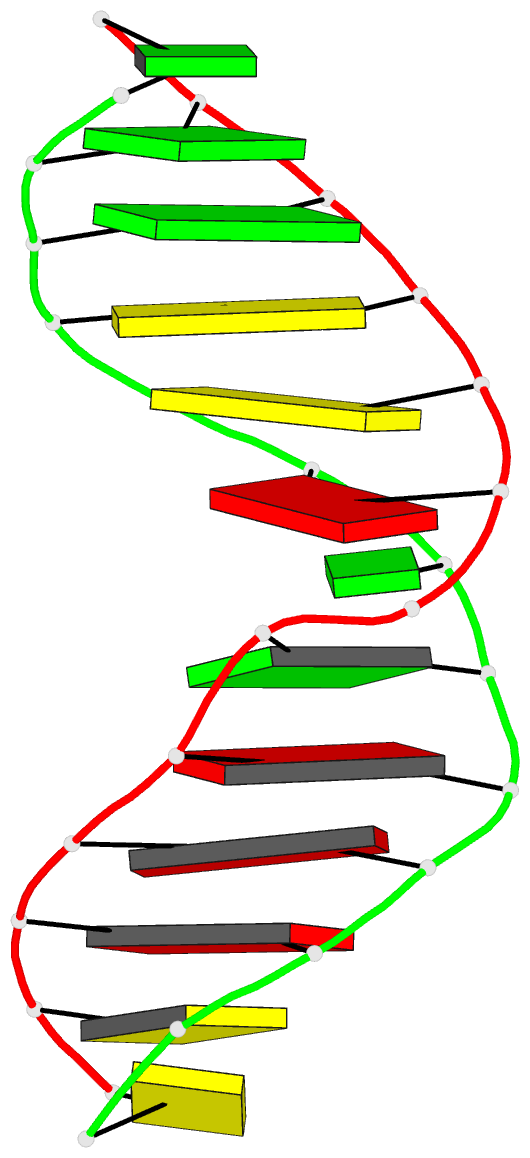
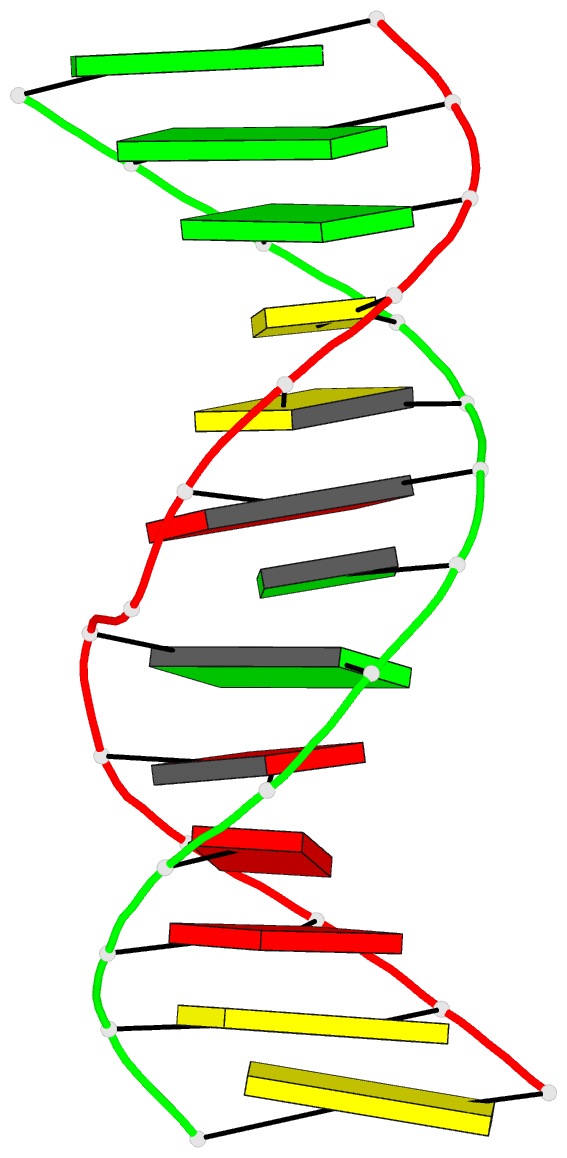
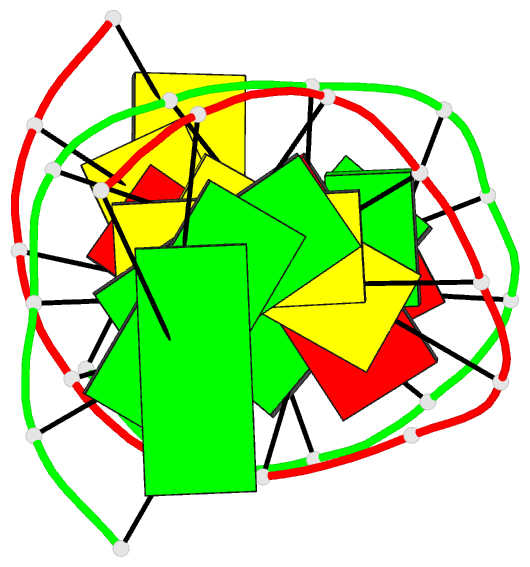
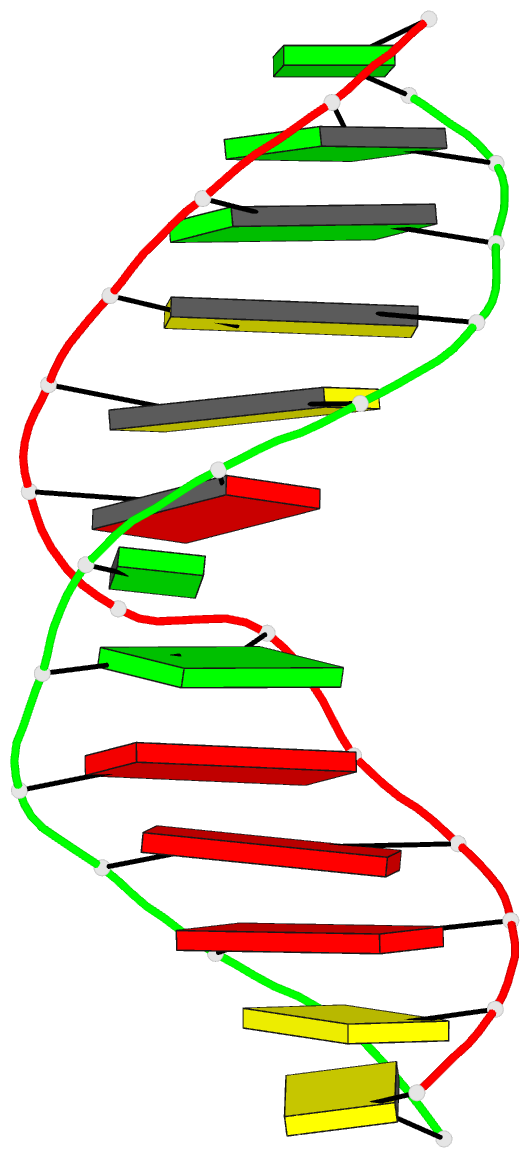
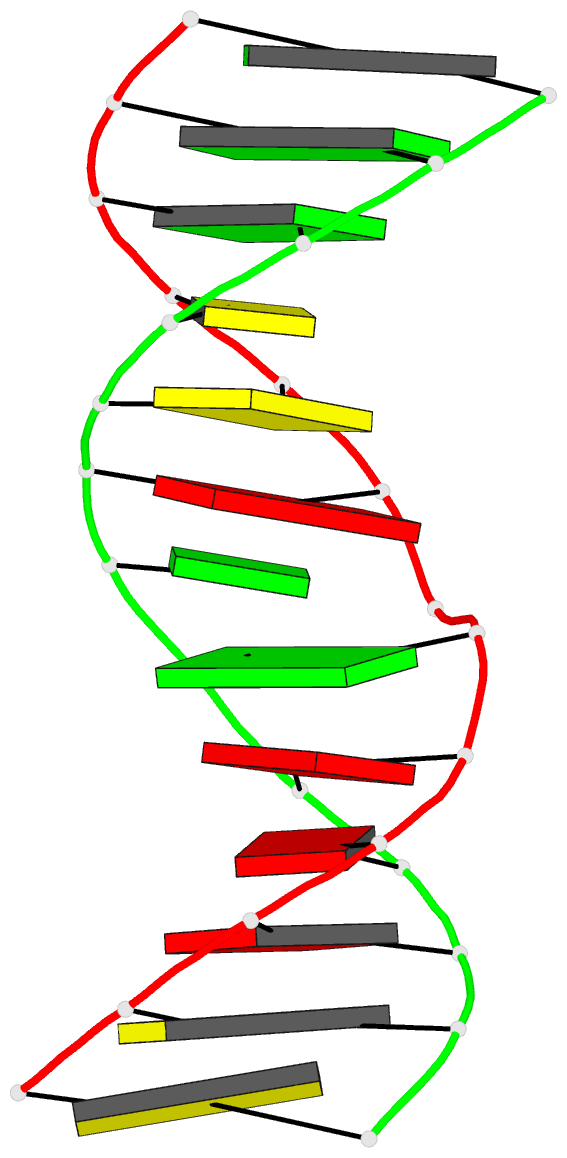
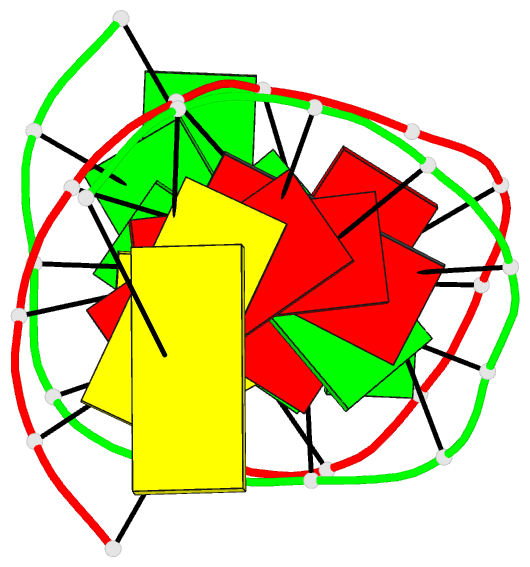
- Duplex DNA containing an abasic site with an opposite g
(beta anomer) in 5'-g_ac-3' (10 structure ensemble and
averaged structure)
- Reference
-
Chen J, Dupradeau FY, Case DA, Turner CJ, Stubbe J
(2008): "DNA
oligonucleotides with A, T, G or C opposite an abasic
site: structure and dynamics." Nucleic Acids
Res., 36, 253-262. doi: 10.1093/nar/gkm622.
- Abstract
- Abasic sites are common DNA lesions resulting from
spontaneous depurination and excision of damaged
nucleobases by DNA repair enzymes. However, the influence
of the local sequence context on the structure of the
abasic site and ultimately, its recognition and repair,
remains elusive. In the present study, duplex DNAs with
three different bases (G, C or T) opposite an abasic site
have been synthesized in the same sequence context (5'-CCA
AAG6 XA8C CGG G-3', where X denotes the abasic site) and
characterized by 2D NMR spectroscopy. Studies on a duplex
DNA with an A opposite the abasic site in the same sequence
has recently been reported [Chen,J., Dupradeau,F.-Y.,
Case,D.A., Turner,C.J. and Stubbe,J. (2007) Nuclear
magnetic resonance structural studies and molecular
modeling of duplex DNA containing normal and 4'-oxidized
abasic sites. Biochemistry, 46, 3096-3107]. Molecular
modeling based on NMR-derived distance and dihedral angle
restraints and molecular dynamics calculations have been
applied to determine structural models and conformational
flexibility of each duplex. The results indicate that all
four duplexes adopt an overall B-form conformation with
each unpaired base stacked between adjacent bases
intrahelically. The conformation around the abasic site is
more perturbed when the base opposite to the lesion is a
pyrimidine (C or T) than a purine (G or A). In both the
former cases, the neighboring base pairs (G6-C21 and
A8-T19) are closer to each other than those in B-form DNA.
Molecular dynamics simulations reveal that transient H-bond
interactions between the unpaired pyrimidine (C20 or T20)
and the base 3' to the abasic site play an important role
in perturbing the local conformation. These results provide
structural insight into the dynamics of abasic sites that
are intrinsically modulated by the bases opposite the
abasic site.