Summary information and primary citation
- PDB-id
-
4j9m;
DSSR-derived features in text and
JSON formats
- Class
- transferase-DNA
- Method
- X-ray (2.25 Å)
- Summary
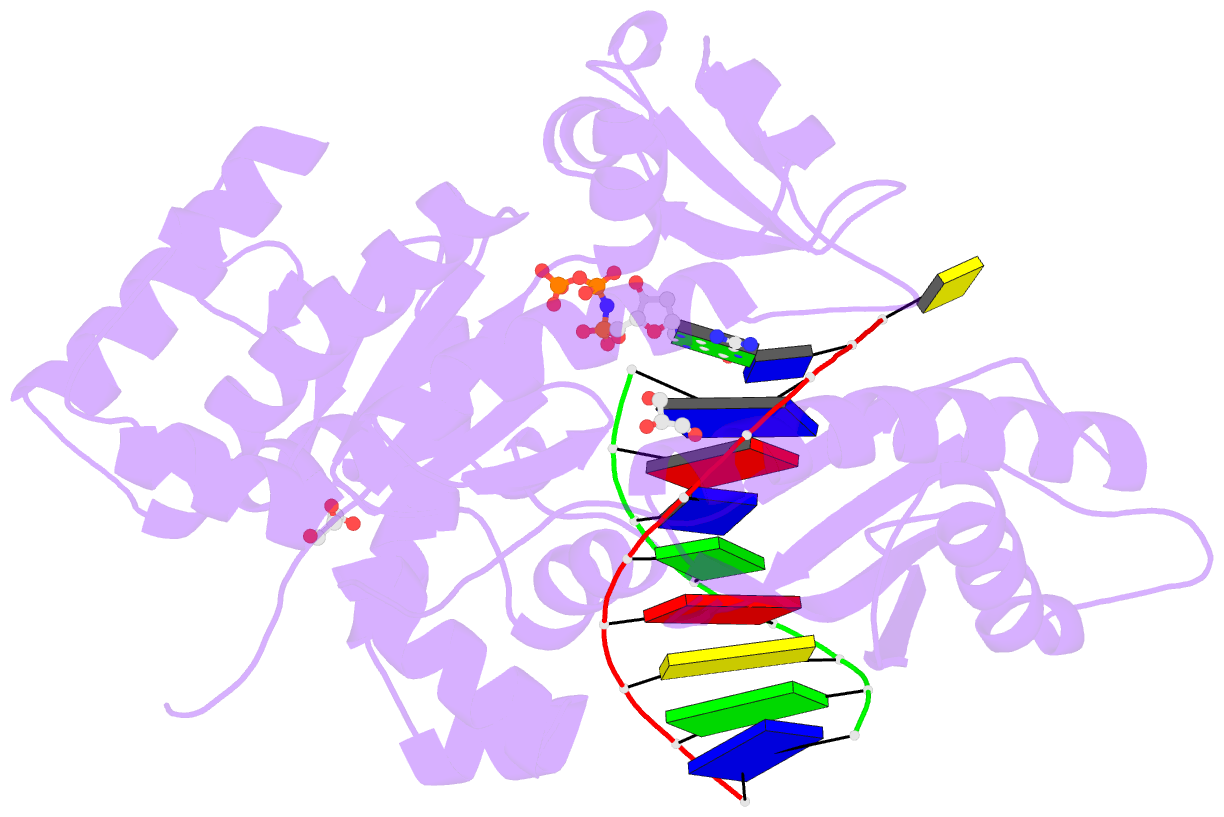
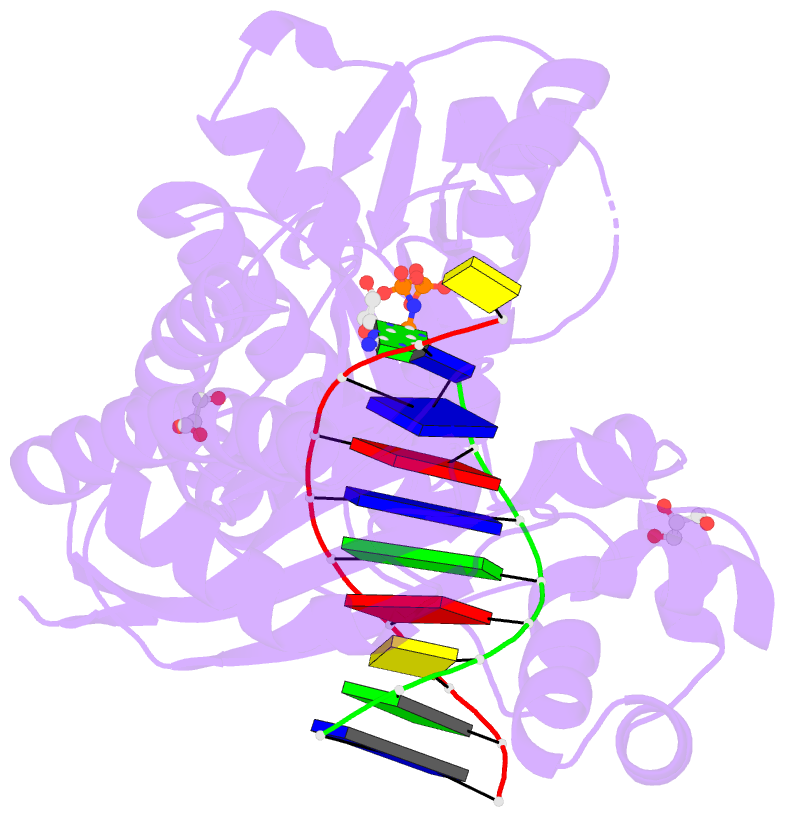
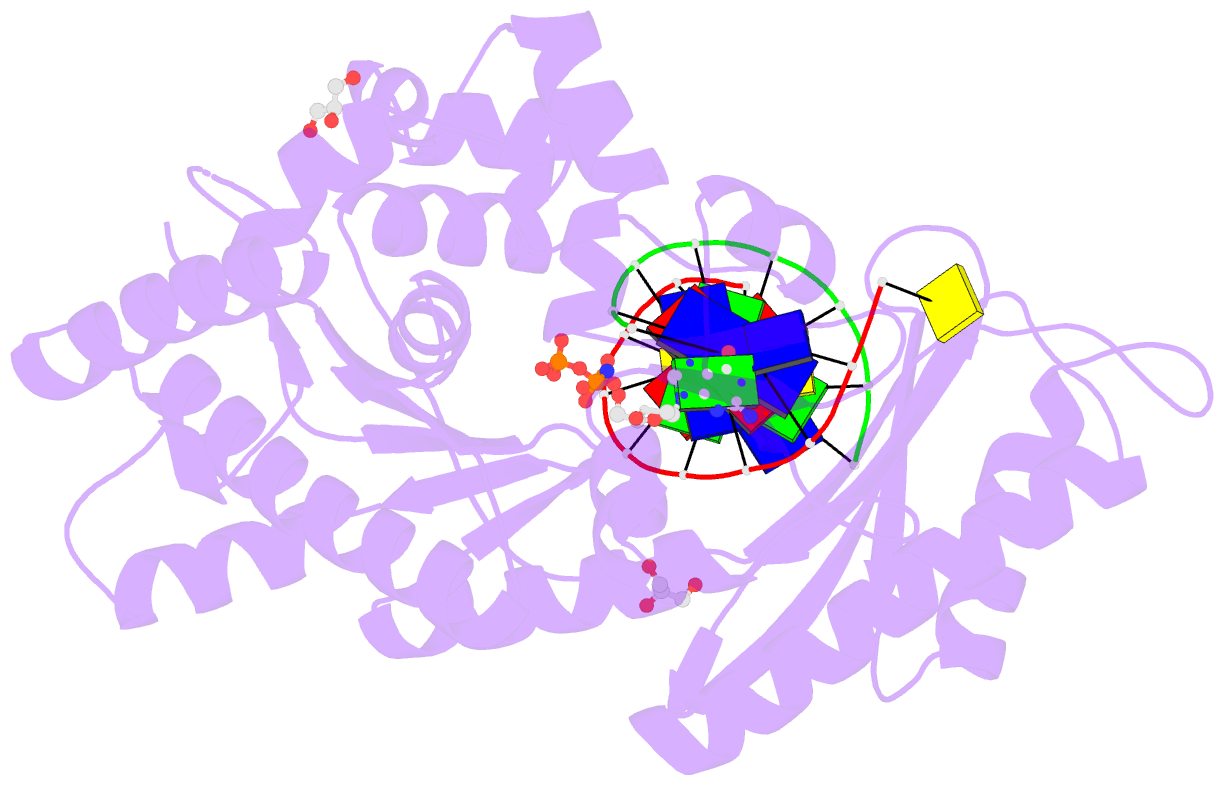
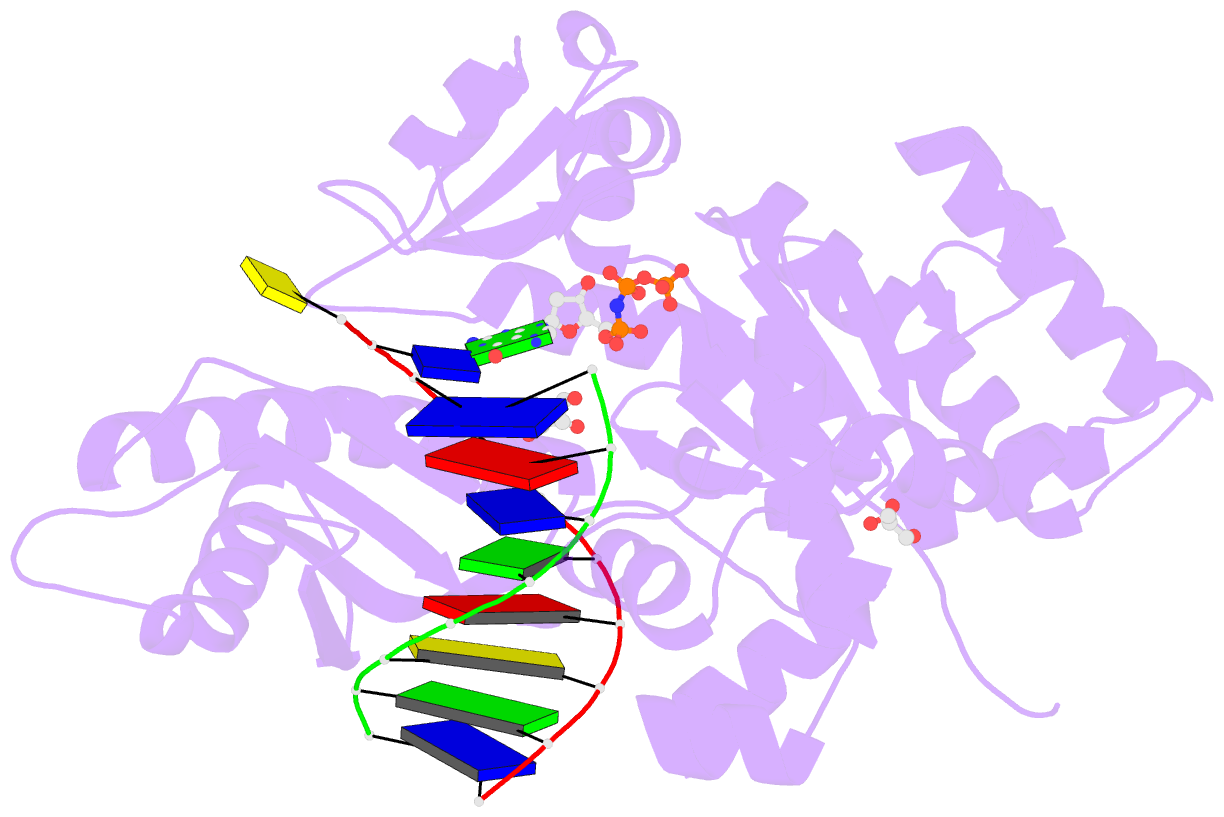
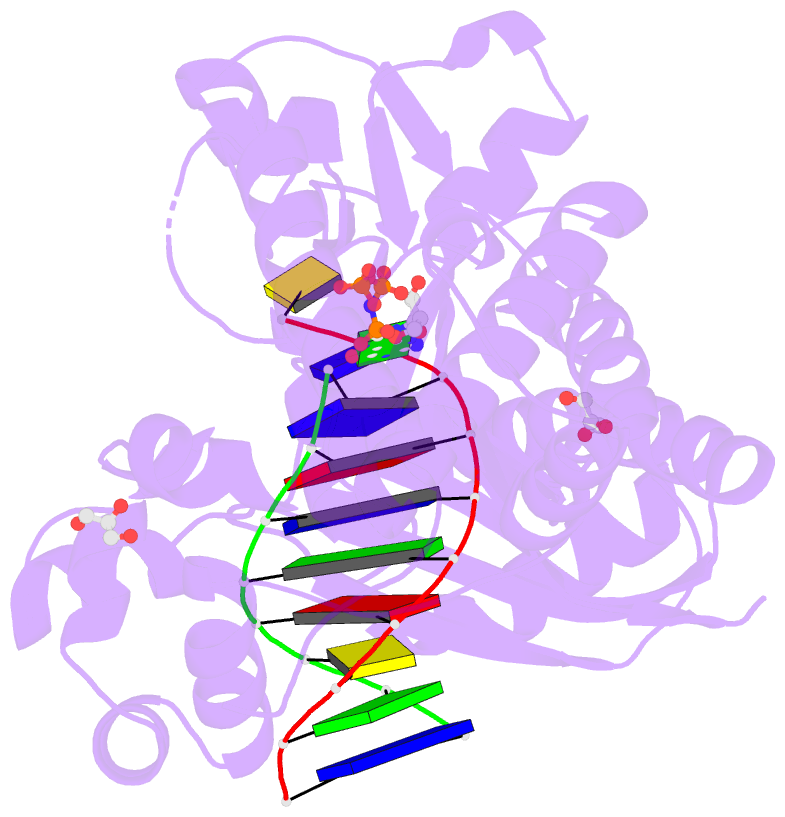
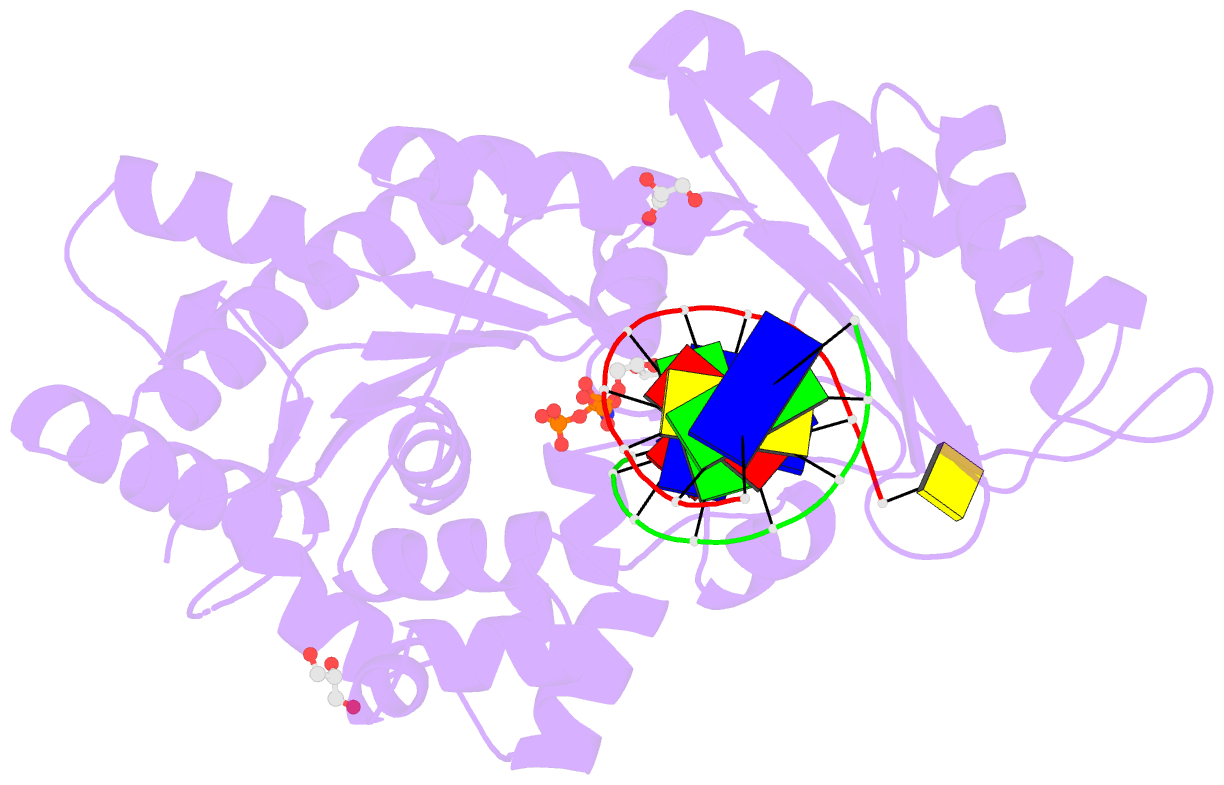
- Human DNA polymerase eta-DNA ternary complex:
misincorporation g opposite t after an a at the primer 3'
end (aa-g)
- Reference
-
Zhao Y, Gregory MT, Biertumpfel C, Hua YJ, Hanaoka F,
Yang W (2013): "Mechanism
of somatic hypermutation at the WA motif by human DNA
polymerase eta." Proc.Natl.Acad.Sci.USA,
110, 8146-8151. doi: 10.1073/pnas.1303126110.
- Abstract
- Somatic hypermutation is programmed base substitutions
in the variable regions of Ig genes for high-affinity
antibody generation. Two motifs, RGYW and WA (R, purine; Y,
pyrimidine; W, A or T), have been found to be somatic
hypermutation hotspots. Overwhelming evidence suggests that
DNA polymerase η (Pol η) is responsible for converting the
WA motif to WG by misincorporating dGTP opposite the
templating T. To elucidate the molecular mechanism, crystal
structures and kinetics of human Pol η substituting dGTP
for dATP in four sequence contexts, TA, AA, GA, and CA,
have been determined and compared. The T:dGTP wobble base
pair is stabilized by Gln-38 and Arg-61, two uniquely
conserved residues among Pol η. Weak base paring of the W
(T:A or A:T) at the primer end and their distinct
interactions with Pol η lead to misincorporation of G in
the WA motif. Between two WA motifs, our kinetic and
structural data indicate that A-to-G mutation occurs more
readily in the TA context than AA. Finally, Pol η can
extend the T:G mispair efficiently to complete the
mutagenesis.