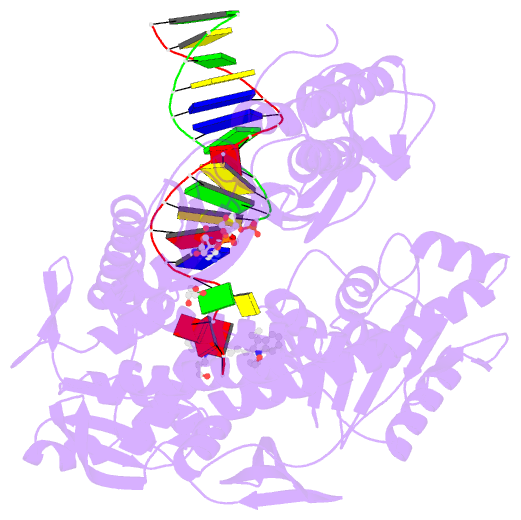
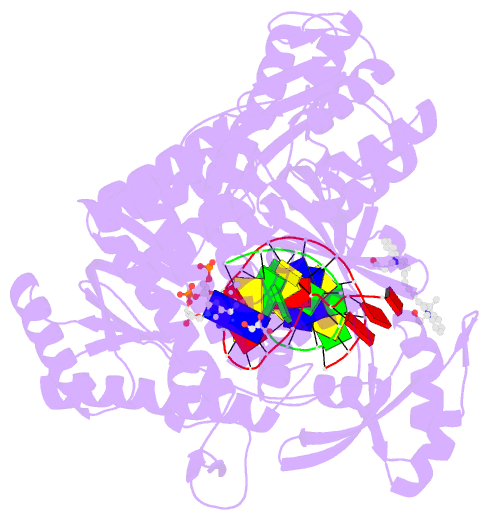
Summary information and primary citation
- PDB-id
-
9oau;
DSSR-derived features in text and
JSON formats
- Class
- transferase-DNA
- Method
- X-ray (2.18 Å)
- Summary
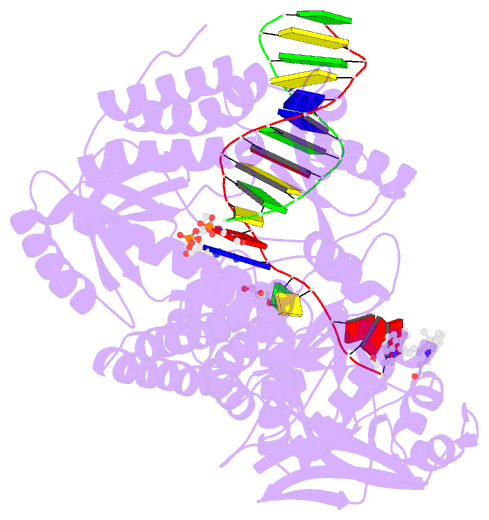
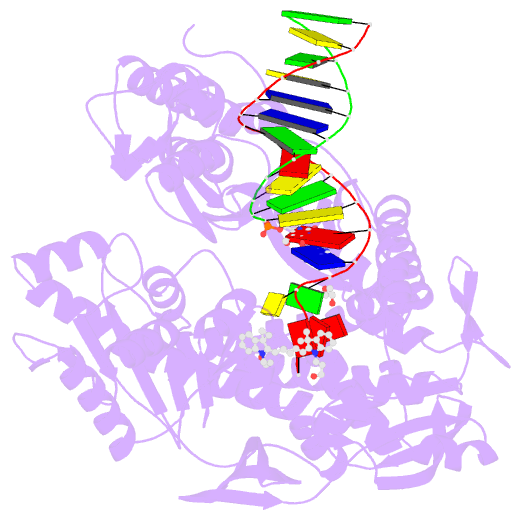
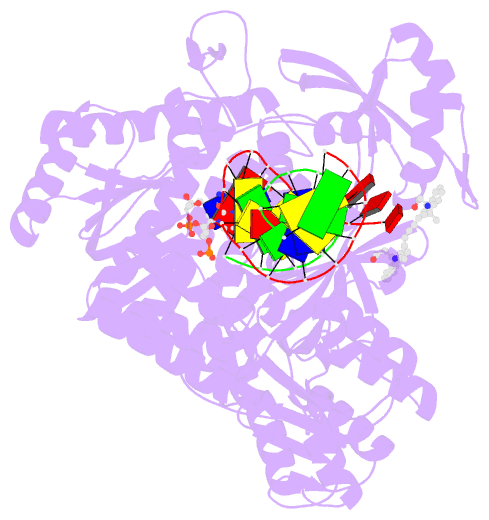
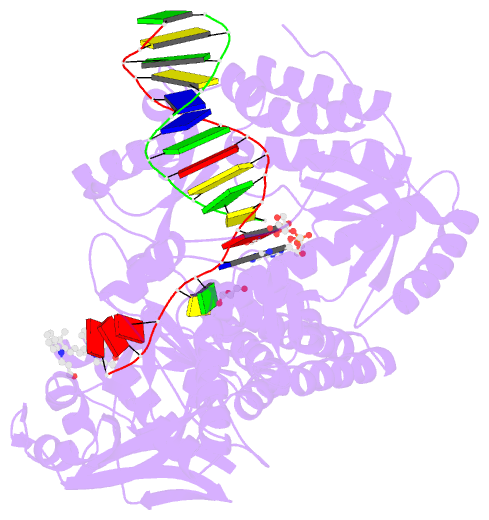
- Tna polymerase, 7-47, binary complex
- Reference
-
Hajjar M, Maola VA, Lee JJ, Holguin MJ, Quijano RN,
Nguyen KK, Ho KL, Medina JV, Botello-Cornejo E, Barpuzary
B, Chim N, Chaput JC (2025): "Directed
evolution of a TNA polymerase identifies independent
paths to fidelity and catalysis." Nat
Commun, 17, 925. doi: 10.1038/s41467-025-67652-1.
- Abstract
- Directed evolution facilitates functional adaptations
through stepwise changes in sequence that alter protein
structure. While most campaigns yield solutions that
maintain the framework of a rigid protein architecture, a
few have produced enzymes with more notable structural
differences. One example is a polymerase that was evolved
to synthesize threose nucleic acid (TNA) with near-natural
activity. Understanding how this enzyme arose provides a
model for studying pathways that guide enzymes toward more
productive regions of the fitness landscape. Here, we trace
the evolutionary trajectory of an unnatural polymerase by
solving crystal structures of key intermediates along the
pathway and evaluating their biochemical activity. Contrary
to the view that fidelity is a product of increased
catalytic efficiency, we find that accuracy and catalysis
are decoupled activities guided by separate ground-state
and transition-state discrimination events. Together, these
results offer a glimpse into the forces responsible for
shaping the emergence of new enzyme functions.